

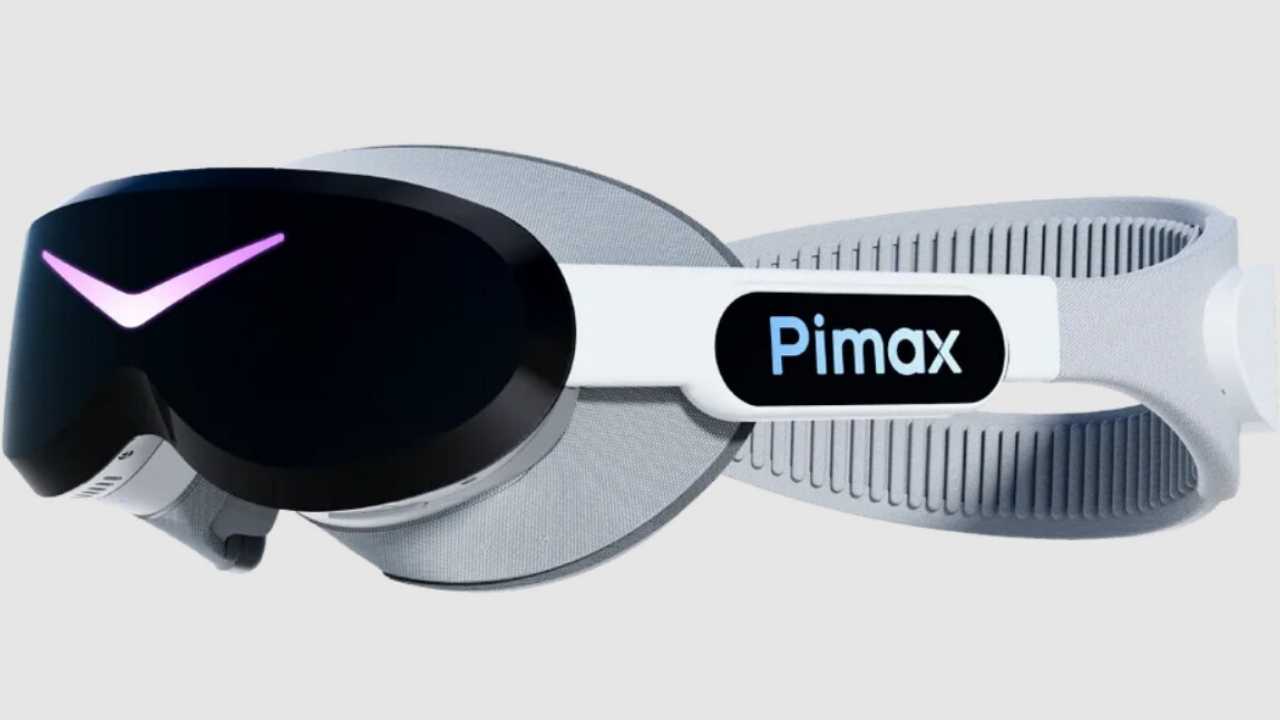
Pimax VR Headsets: Pimax has been a leader in the world of virtual reality for a long time, where immersion is the holy grail. The company is known for pushing the limits of field of view (FOV) in VR headsets. Now, it is focusing on micro-OLED displays, which are said to be the future of VR because they have the highest pixel density and contrast. On September 19, 2025, Pimax showed off three new headsets that changed the game: the Dream Air SE, the Dream Air, and the Crystal Super Micro-OLED. These devices not only combine micro-OLED panels with pancake optics, but they also have the widest FOV ever achieved in micro-OLED VR, which sets a new standard for visual fidelity and spatial awareness.
Micro-OLED technology uses tiny organic light-emitting diodes to make pictures. It promises blacks that look like they came from a movie, infinite contrast ratios, and resolutions that make pixels almost invisible. But it hasn’t been able to be used in VR because of problems like heat dissipation, optical distortions, and a limited field of view because the panels are so small. When you try to make the view bigger with traditional VR optics, they often lose clarity, which causes “screen-door” effects or edge blurring. Pimax has come up with a solution using its own ConcaveView three-element pancake optics, despite the fact that it was not going to give up. This new technology folds light paths in a way that keeps things small while making them more immersive. What happened? Headsets that combine the sharpness of micro-OLEDs with field of views (FOVs) that are as wide as the human eye’s natural peripheral vision—up to 128 degrees diagonal in the flagship model.
The Dream Air SE is the most important part of this lineup. It is Pimax’s first affordable, portable micro-OLED VR headset. This headset costs $899 and weighs less than 170 grams, which is less than most smartphones. It’s great for long sessions without putting too much strain on your neck. It has Sony micro-OLED panels with a resolution of 3,840 x 3,552 pixels per eye, which is more than 27 million pixels in total. This gives it amazing detail. The FOV is 110 degrees wide and 120 degrees diagonal, which is impressive for such a small size. With built-in 6DOF SLAM tracking, there is no need for external base stations. Tobii eye-tracking and dynamic foveated rendering improve performance by only rendering high detail where the user looks. The Dream Air SE is now a powerful stand-alone device for gaming, work, or mixed-reality passthrough thanks to its built-in spatial audio.
The Dream Air is built on the same base as its sibling, but it adds even more premium portability. It also weighs less than 170 grams and has better Sony panels with higher brightness, deeper color depth, and a 20-degree chief ray angle to cut down on glare and edge distortion. The 110-degree horizontal FOV and 8K-equivalent resolution per eye are the same, but optimized stereo overlap makes sure that you can see everything around you without the “tunnel effect” that happens with narrower headsets. Pimax calls the Dream Air the “world’s smallest full-feature 8K VR headset” and talks about how well it balances size, weight, and immersion. People who got it early love how clear it is from edge to edge, saying that the pancake lenses make it look like a “window to another world” instead of a flat screen.
The Crystal Super Micro-OLED, Pimax’s flagship product, is the crown jewel. It sets a new standard for high-end VR. At $2,199, this modular beast fits into the existing Crystal ecosystem and lets users switch out optical engines for personalized experiences, whether they want to game in ultrawide or focus on productivity. The 3,840 x 3,552 resolution per eye is the same as on other Sony micro-OLED panels, but the FOV is what really sets it apart: 116 degrees horizontally and over 128 degrees diagonally. This is the widest FOV ever on a micro-OLED VR headset, beating the Apple Vision Pro (100 degrees horizontal) and the Varjo XR-4 (120 degrees, but not as good contrast as micro-OLED). Pimax’s ConcaveView optics do this without losing the sweet spot, which is the central area of sharp focus that covers almost the whole view and reduces distortion at the edges.
It’s not just the specs that make these headsets different; it’s the whole engineering. Pimax solved micro-OLED’s heat problems with better heat sinks and airflow designs, so the panels stay cool even when you play for a long time. The optics, which are made up of three elements in a pancake shape, use aspheric glass to bend light exactly, which gives them high pixels-per-degree (PPD) ratings—up to 57 PPD in clarity modes—and increases the field of view. This mix gives you pictures that look like a 200-inch IMAX screen right in front of your face, with no visible pixels or god rays. Eye-tracking technology makes dynamic foveated rendering even better, increasing frame rates to 90Hz or higher. This is important for smooth motion in fast-paced games like flight simulators or FPS games.
For users, the effects are very big. The wider FOV improves situational awareness in games. For example, in a heated multiplayer match in Half-Life: Alyx, you could see enemies in your peripheral vision without turning your head. For people who love simulations, like pilots in Microsoft Flight Simulator 2024, the Crystal Super’s wide view shows cockpit instruments and horizons in a way that makes them look real, and it reduces motion sickness by letting the head move naturally. The modular design is great for productivity users because you can switch to passthrough mode for AR overlays in tools like Adobe Substance or Microsoft Mesh for collaborative spaces. Even in entertainment, the infinite contrast of micro-OLED makes dark scenes in The Mandalorian on Disney+ pop with depth, and spatial audio makes you feel like you’re in the middle of an orchestral swell.
These claims are believable because of Pimax’s past. Since 2017, the company has been a leader in wide-FOV VR. The Pimax 8K series won CES awards for resolutions up to 7K per eye. The Crystal line, which came out in 2024, won innovation awards for its local dimming and QLED backlights. Pimax’s lead is now even stronger thanks to micro-OLED. Beta testers’ reviews back this up. One DCS World pilot called the Crystal Super “visceral” and said that its FOV made racing sims like Automobilista 2 feel “blown away” compared to the Meta Quest 3 or PSVR2. Another person called it “the best VR headset ever,” saying that it had a high frame rate even though the PPD was very high.
There are still problems to solve, of course. The Crystal Super costs $2,199 and is aimed at serious gamers rather than casual users. SLAM tracking is new, but it might not be as accurate as Valve’s Lighthouse for room-scale tracking. For the best performance, you’ll need a high-end PC with RTX 40-series GPUs and software like Pimax Play to make sure updates go smoothly. Still, Pimax makes up for these things with its Prime program, which gives lifetime support, prescription lens inserts, and even prototype loans to early backers. You can now place pre-orders, and the first shipments will go out in late 2025. Pioneers will get bonuses like Le Mans Ultimate.
These headsets show that micro-OLED VR is getting more mature. Thanks to Pimax’s vertical integration, which includes everything from panels to software, the technology is no longer limited to prototypes from Varjo or Apple. Pimax’s full lineup, from budget to flagship, makes it easier for everyone to get access as competitors like Meta and HTC try to catch up. The Dream Air SE, which costs $899, makes it easier to get high-quality visuals without spending a lot of money.
Pimax’s new headsets are revolutionary in a market full of small improvements. They don’t just give you a wider view; they change the way you see the world by combining the precision of micro-OLED with the widest FOV yet. These devices invite you to step outside of the screen, whether you’re a gamer looking for thrills, a creator building worlds, or a sim fan looking for realism. Pimax is the first company to make VR that is both narrower and sharper.