

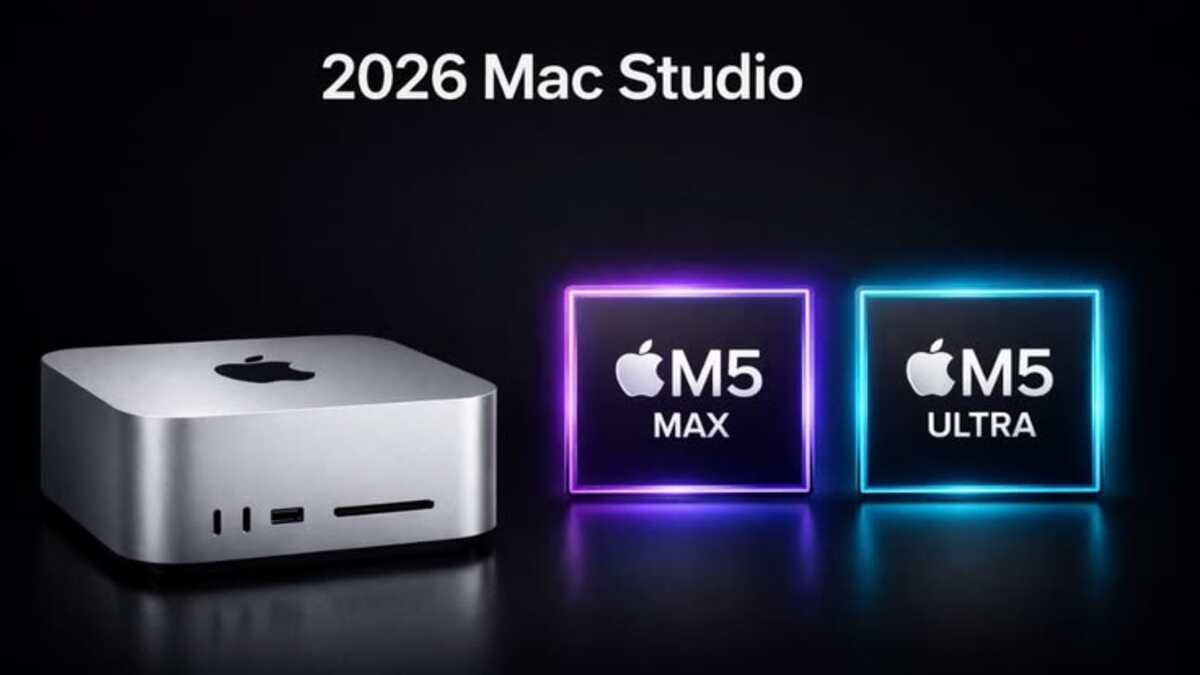
Apple has upgraded two of its most useful desktop computers with processors that make AI the focus of routine computing. The new Mac mini features the company’s first 2-nanometer chip, the M6, while the Mac Studio boasts the powerful M5 Ultra, a quad-die design aimed at the most intensive pro and local AI tasks. Both systems are available to preorder now and are due to start shipping on September 22. The M6 is an obvious evolution in Apple silicon.
Assembled on a next-gen 2 nanometer process, it includes a 12-core CPU. With eight super cores, two performance cores and six efficiency cores. A 12 core GPU each with a dedicated Neural Accelerator follows, with a dual 16 core Neural Engine for achieving new heights for on-device machine learning.
The memory bandwidth increases to 170 gigabytes per second. With starting at 16GB of unified memory, which can be expanded to 32GB.Apple claims the M6 Mac mini is approximately twice as speedy as the previous M4-based mini in many circumstances, though the form factora svelte aluminum shellremains largely unchanged. The M5 Ultra is like the M2 Ultra, only for the users who need some additional headroom. It ties together two of the M5 Max dies through an enhanced UltraFusion interconnect and forms Apple’s first four die system-on-a-chip. One that scales to a whopping 36 CPU cores and 80 GPU cores, with the Neural Accelerator present on each and every one of the latter. Unified memory bandwidth is once again 50 percent higher, climbing to 1.
2 terabytes/sec. Support for a maximum of 512 gigabytes of high bandwidth memoryand keep in mind you probably want something with a lot of memory if you’re running a large language model locally, because you’re talking about a lot of cloud roundtripsrolls in this chip. A standard M5 Ultra Studio configuration starts at 5,499 dollars. The Neural Accelerators are significant because these are directly embedded in the GPU itself and will accelerate AI for inference and media that was previously performed by dedicated neural engines or to the cloud services.
Creatives can anticipate more seamless realtime effects in workstation video editing, faster recognition of objects in photo libraries, and more real-time local assistants. ML developers will now be able to train and run larger networks within their own machines without renting remote clusters. General users will see it in quieter fans, extended battery life on their connected devices, and a more immediate experience overall.
The Mac mini is still the same svelte little brick, ready to slip behind your monitor or lift and carry up to your office. The Studio leads the charge here on density and expandability, with more available ports and the ability to run two or more high-res monitors. Both systems are shipping with the new upgraded macOS 27 Golden Gate enabled, so the software stack can use this new silicon straight away. The prices have crept up. The entry M6 Mac mini is now 899 dollars. This is a modest step up, considering the process node shift, and the extra AI hardware.