

WhatsApp has long been influential in the way billions of people communicate. Alongside popularising voice messages and developing a unifying visual communication tool in the form of stickers, it also consistently provides end-to-end encryption. Recently it has been experimenting with a subtle new addition to its sticker functionality – adding audio to stickers.
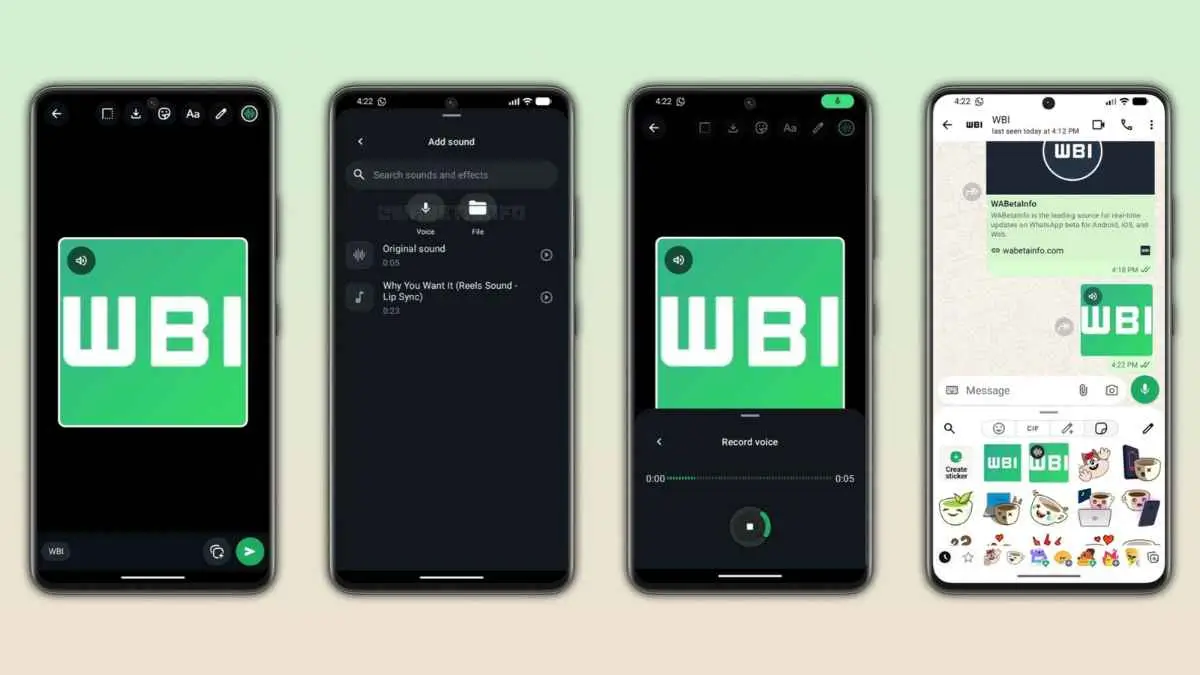
Within the latest Android beta version (2.26.47.1) users are able to generate ‘audio stickers’; these are moving stickers which include an accompanying piece of audio. Firstly, users can access the sticker keyboard and select the option to ‘Create sticker,’. They can then import a video from their gallery which WhatsApp will animate. There is then a further option to retain the video’s original audio, apply a pre-defined audio effect, insert your own audio file and/or add a voice message.
Overall, generated videos are usually around 10 seconds in length (and often shorter if sourced from a video). Upon sending, a tiny loudspeaker symbol is added to the sticker. This does not play audio until it is manually pressed and then plays three times before halting. Users’ wishes for silence are acknowledged and both video and audio continue to be end-to-end encrypted.
There is also evident prudence within WhatsApp’s approach. Proactively preventing stickers from playing automatically ensures that audio will not unexpectedly burst forth within groups. Particularly as WhatsApp already includes a multitude of visual and audio features (including GIFs and voice messages alongside alerts), this is an astute choice. Audio stickers provide a good compromise between a mute sticker and a complete voice message, offering enhanced communicative potential. For younger generations in particular, who commonly rely heavily on stickers for communication, the facility to supplement these with humour, memes or individual quotes may appear to be a logical progression.
Nevertheless, alongside the innovation lies recognised potential for issues. As with many novel features, whilst individuals may initially be intrigued, chats can quickly become inundated with reoccurring audio. Furthermore, it is highly likely that those generating audio stickers will push boundaries by including both pirated and/or inappropriate material. This, in turn, will challenge Meta’s monitoring procedures. In addition, there will be additional impact on a device’s battery and data consumption for both frequent senders and viewers of audio stickers. Gradual release of the feature also indicates that Meta is continuing to assess just how much audio ‘stimulation’ people wish to engage with.
Furthermore, Meta’s strategy remains consistent. Continuing to harness the visually and sonically stimulating nature of Instagram and TikTok, it is keen to maintain WhatsApp’s intuitiveness and confidentiality. Whereas rival apps such asTelegram already provide highly personalised options, by integrating audio into stickers, Meta is seeking to be the first to successfully establish itself within a fresh, niche category. Interestingly, iOS users too are currently being trialled for this feature, suggesting that Meta is eager to achieve uniformity across devices following its transition from beta phase.
Whether or not audio stickers will develop into a sustained feature remains to be seen. Provided that Meta sustains the feature’s ease of use, voluntariness and unobtrusiveness, it may successfully augment digital communication in a similar manner to animated stickers previously has. However, should it become excessively stimulating, the majority of users are likely to wholly disregard the loudspeaker emblem and maintain previous behaviour. For now, then, this trial highlights that even the globe’s most used messaging service is still striving to identify further subtle methods of animating digital communication.