

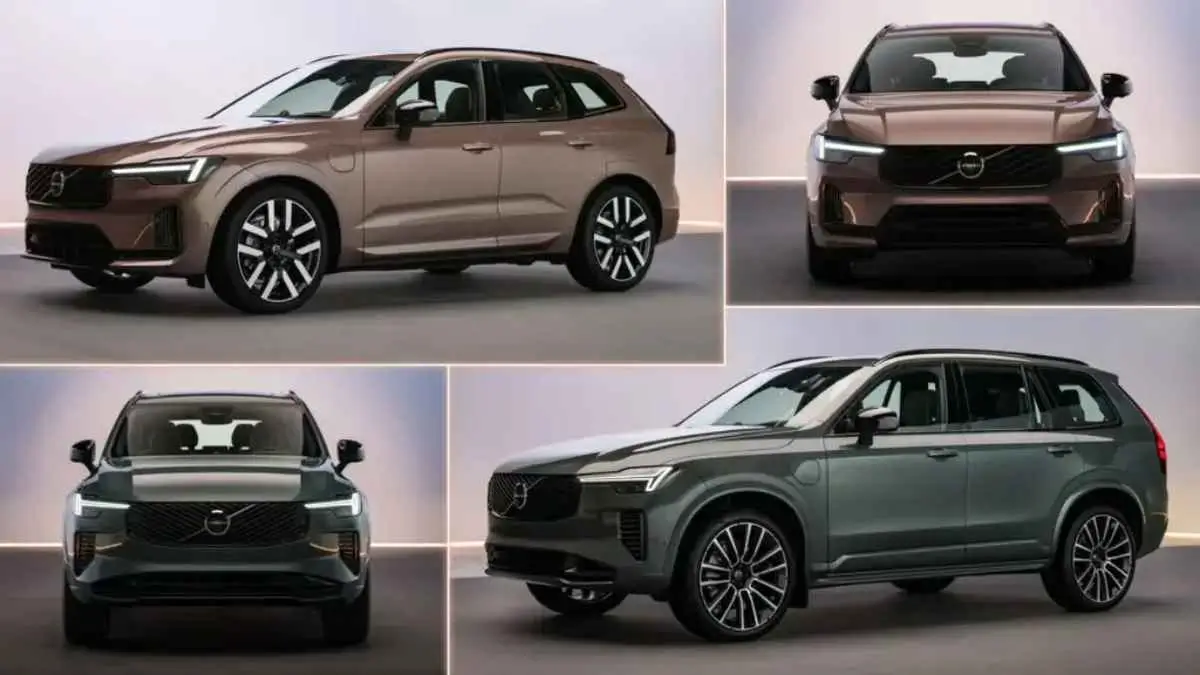
Following the XC90, Volvo has also updated its XC60 plug-in hybrid SUVs. Rather than producing completely new models, these changes mainly focus on boosting an electric-only range, together with technology and interior benefits.
Like the XC90, the XC60 has been given a new front grille and matrix LED headlamps. Both models still utilise the same 2.0 litre 4-cylinder petrol and dual-electric motor hybrid drivetrain.
The petrol engine has 247hp (184kW) and 226lb.ft. (306Nm) of torque. The front and rear electric motors provide 70hp (50kW)/122lb.ft.(165Nm) and 174hp (130kW)/228lb.ft. (309 Nm) respectively. Overall, this gives a huge 455hp (339kW) and 560lb.ft. (759 Nm).
A key enhancement is that the battery has been expanded to have a net capacity of 37.9kWh and a gross capacity of 41.2kWh. In Electric only ‘Pure’ mode, the XC60 has an estimated EPA range of 78 miles (126km) and the XC90 73 miles (116km).
This means numerous people may be able to undertake regular travel on a purely electric basis. Volvo estimates that in Hybrid mode the XC60 and XC90 will demonstrate an average efficiency rating of 67 and 61MPGe respectively.
Around four hours is needed to charge the cars with a Level 2 16amp or greater charger. Approximately 27 hours is required using a standard 120volt socket.
Both XC60 and XC90 also have regenerative breaking and one-pedal driving. Choosing a B gear instead of D enables ‘lift off’ regenerative braking so that electric motors can decelerate the car – before mechanical brakes are used. This is applicable for both Hybrid and Power gears. Furthermore, in Pure mode, both electric motors can also regenerate energy when braking.
Whilst driving, the XC60 is more fun to drive on twisty roads. However, the XC90 has a more laid back feel – especially when travelling at higher speeds. Due to its air suspension the XC90 also has superior sound insulation from the road. Conversely, the XC60 allows more tyre and road sound into the interior. Again, both cars are good for city and extended motorway travel.
New materials including wood and fabric, together with enhanced interior illumination, have also been added. Moreover, the former 9 inch information screen has now been upgraded to an 11.2 inch version. Further, Google Gemini AI has taken over from Google Assistant, providing enhanced speech recognition facilities and internet searching capability.
Enhanced safety features comprise alerts if a cyclist is in proximity to a door and an updated 360 degree parking camera. Nevertheless, neither model provides high level driver support for direct forward driving, nor does it include a similar Level 2+ no-hand-holding function to that provided by some other manufacturers’ cars.
The updated XC60 and XC90 are anticipated to be available from the beginning of 2027. As yet, Volvo has not revealed pricing details. Considering the enhanced battery size and technology, there may well be a slight rise in cost. Nonetheless, it will be interesting to see exactly what value for money proposition is provided once prices are confirmed.
Reported by Ars Technica.