

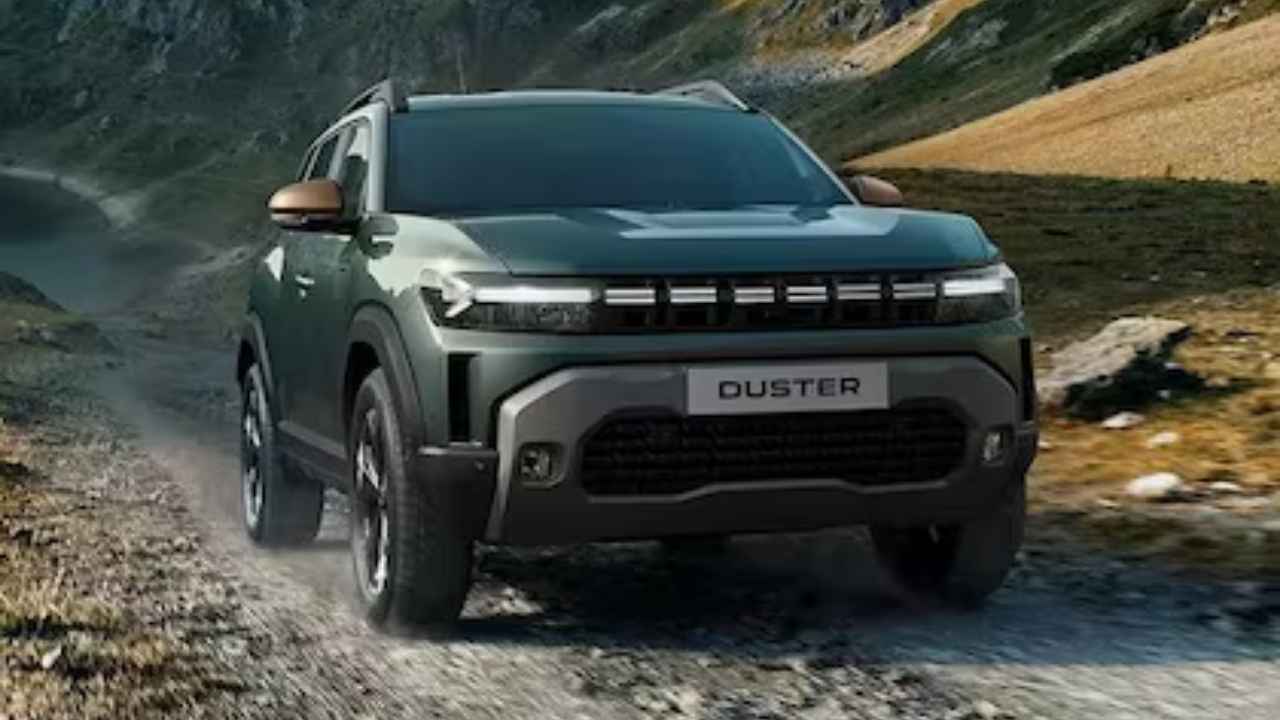
Renault Duster 2026: The compact SUV market in India has become a battleground for big car companies, with the Hyundai Creta, Kia Seltos, and Maruti Suzuki Grand Vitara being the best-selling models. In the midst of all this fierce competition, Renault is getting ready to make a triumphant return with the third-generation Duster, a nameplate that once changed the market. The original Duster, which came out in 2012, started the trend of cheap SUVs. It sold over 7 lakh units in India before it was discontinued in 2022. Renault has officially announced that the new Duster will be available in early 2026, specifically around March. The company hopes to regain its throne with a modern design, flexible powertrains, and prices that are good value for money. This launch isn’t just a new product; it’s a strategic move by Renault India to get back some market share in a segment that is expected to grow by 15% every year.
Production of the new Duster will begin in September 2025 at Renault-Nissan’s Chennai plant. This will keep costs down and make sure that the car meets India’s strict emissions standards. The SUV will cost between ₹10 lakh and ₹15 lakh (ex-showroom), which will put it in a good position against more expensive competitors while still offering premium features. Francisco Hidalgo, Renault’s Vice President of Sales and Marketing, talked about how the brand makes people feel: “It is as if Renault is Duster and Duster is Renault.” There is a lot of excitement in the air, and dealers say they are getting advance bookings from loyal customers who want to be the first in line. As India moves toward greener transportation, the Duster’s ability to run on petrol, CNG, and hybrid fuels makes it a smart choice for both city dwellers and highway adventurers.
The 2026 Renault Duster is built on the flexible CMF-B platform, which Renault and Nissan worked together to create. This platform can support a wide range of powertrains, from internal combustion to electric. This modular architecture, which is already used in cars like the Renault Triber and Nissan Magnite, promises to make the structure stronger, distribute weight better, and make the car safer. Spy photos taken on Indian roads show a shape that is both tough and elegant, with a length of about 4.3 meters, which is a little longer than the previous model to give it more room inside. The outside design is based on the global Dacia Duster that came out in 2024. It combines boxy, muscular shapes with a modern touch. Up front, a wide grille with the new Renault logo is framed by bold Y-shaped LED daytime running lights (DRL). Sleek LED headlights and thick skid plates give the car an off-road-ready look.
The SUV’s side profile shows off its capabilities with big wheel arches, dual-tone 17-inch alloy wheels, and blacked-out roof rails that suggest roof-mounted accessories that can be added. The sporty look of the back includes wraparound Y-shaped LED tail lights, a sculpted tailgate with “Duster” badging, and a roof spoiler that is built in. There will probably be bright colors like Glacier White, Terracotta Brown, and Cedar Green, and higher trims will have two-tone schemes. Renault promises that the car will have more than 200 mm of ground clearance, which will help it handle India’s bumpy roads and monsoons. Changes to the aerodynamics, like active grille shutters, could make highways more efficient by lowering the drag coefficient to less than 0.35.
The Duster’s cabin has a high-end, driver-focused feel that is very different from the old model’s utilitarian look. The dashboard has two 10.1-inch digital screens: a customizable driver’s display for navigation and vehicle stats, and a touchscreen infotainment system that works with Android Auto and Apple CarPlay wirelessly. The Arkamys 3D six-speaker sound system makes the sound feel real, and the eight-color ambient lighting sets the mood. The top models have ventilated front seats and a panoramic sunroof, which gives the car a light, open feel. The materials include soft-touch plastics, faux leather, and fabric upholstery. The trunk space is 475 liters, but it can be expanded to 1,600 liters by folding down the back seats. This is great for weekend trips or grocery shopping.
Safety is the most important thing, and the global model gets a 3-star Euro NCAP rating. Expect six airbags, electronic stability control (ESC), hill-hold assist, and a camera that can see all the way around the car. Higher trims might have advanced driver aids like adaptive cruise control, lane-keep assist, and automatic emergency braking. This fits with India’s push for cars with ADAS. Renault’s Easy Link connectivity lets you control the AC from afar with an app, get updates over the air, and use Alexa to give voice commands.
The Duster’s best feature is its variety of powertrains, which appeals to Indian buyers who care about fuel efficiency. It comes with only petrol engines at first, but it has a 1.0-liter turbo-petrol engine (TCe90) that makes 90bhp and 160Nm and can be paired with a 6-speed manual or CVT automatic for city-friendly efficiency (expected 18–20 kmpl). For those who want speed, a 1.3-liter turbo-petrol (TCe150) engine with 150bhp and 250Nm is paired with a 7-speed DCT for quick acceleration (0 to 100 km/h in less than 10 seconds). Front-wheel drive is standard, but some trims offer all-wheel drive (AWD) for light off-roading.
But the real change comes later, when a strong-hybrid setup is added within 6 to 12 months of the launch. This will be based on the European Duster’s E-Tech system. This car has a 1.6-liter gasoline engine, two electric motors, and a 1.2kWh battery that work together to make 140bhp. It can drive on electric power alone for up to 80% of the time in city cycles. Renault says that the combined mileage is over 25 kmpl, which cuts down on running costs in busy cities. There is also a CNG version being tested, probably with the 1.0-liter engine. This is great for tier-2 cities where green fuel infrastructure is growing. Some people might be disappointed that there isn’t a diesel option, but Renault says this is because of BS6 Phase 2 rules and a focus on hybrids. Enthusiasts, on the other hand, miss the old 1.5-liter engine’s torque.
The Duster is just the beginning of a bigger Renault revival. The seven-seater Boreal (codenamed Bigster) is next in line. It will be a stretched version that comes out in mid-2026 and costs between ₹12 and ₹18 lakh. This three-row SUV, which shares the CMF-B platform, is aimed at families who want to compete with the Mahindra XUV700 and Tata Safari. Nissan, Renault’s partner in the alliance, will release a rebadged version, possibly the Terrano revival, which will make the two companies bigger. Under the “Renault. Rethink” brand, which focuses on sustainability and innovation, Renault plans to launch five new models in the next two years. These will include facelifts for the Kwid and Kiger.
There is a lot of competition in this field. The Hyundai Creta and Kia Seltos are the best hybrids for 2027, but Maruti’s Grand Vitara and Toyota Hyryder already have great hybrids. The Volkswagen Taigun and Skoda Kushaq are fun to drive because they have turbo-petrol power, and the Honda Elevate has smooth handling. What makes the Duster better? Unbeatable value: the starting price of ₹10 lakh is lower than that of most competitors, and it comes with all-wheel drive and hybrid options that other companies charge extra for. Renault’s service network, which now has more than 500 locations, promises low ownership costs (less than ₹0.30/km for petrol).
The Duster’s return is good for the market. In FY25, India sold 2.5 million SUVs, and sales of hybrids grew 40% year over year as fuel prices rose (petrol at ₹100/litre). Government incentives for CNG and hybrids, like rebates of up to ₹50,000, will make deals even better. Renault wants to increase its market share from 1.5% to 3-4% by 2027, using the model’s popularity as a selling point. People who are early adopters, like fleet operators, are already asking about it because the Duster has a proven track record of reliability (over 90% retention after five years).
Some people might question how well Renault did it, since the old model had problems with quality and not enough dealers. But recent updates, like the facelifted Kiger, show that things are getting better, with 4-star Global NCAP ratings. The Duster’s hybrid technology should work just as well here as it does in Europe, where more than 100,000 units have been sold. For people who love to go off-road, the AWD system with hill descent control brings back the adventurous spirit of the original. The new Renault Duster isn’t just a new car; it’s a rebirth as 2026 begins. It fits with Renault’s “Rethink” philosophy of making mobility affordable, flexible, and electric for everyone. This SUV promises to bring back the love for the brand that made SUVs accessible to everyone, whether you’re driving through Mumbai’s monsoons or cruising through the Himalayas. Reservations will be available early next year. Will you be in line? The Duster is ready to dust off the competition again in a market that wants to shake things up.