

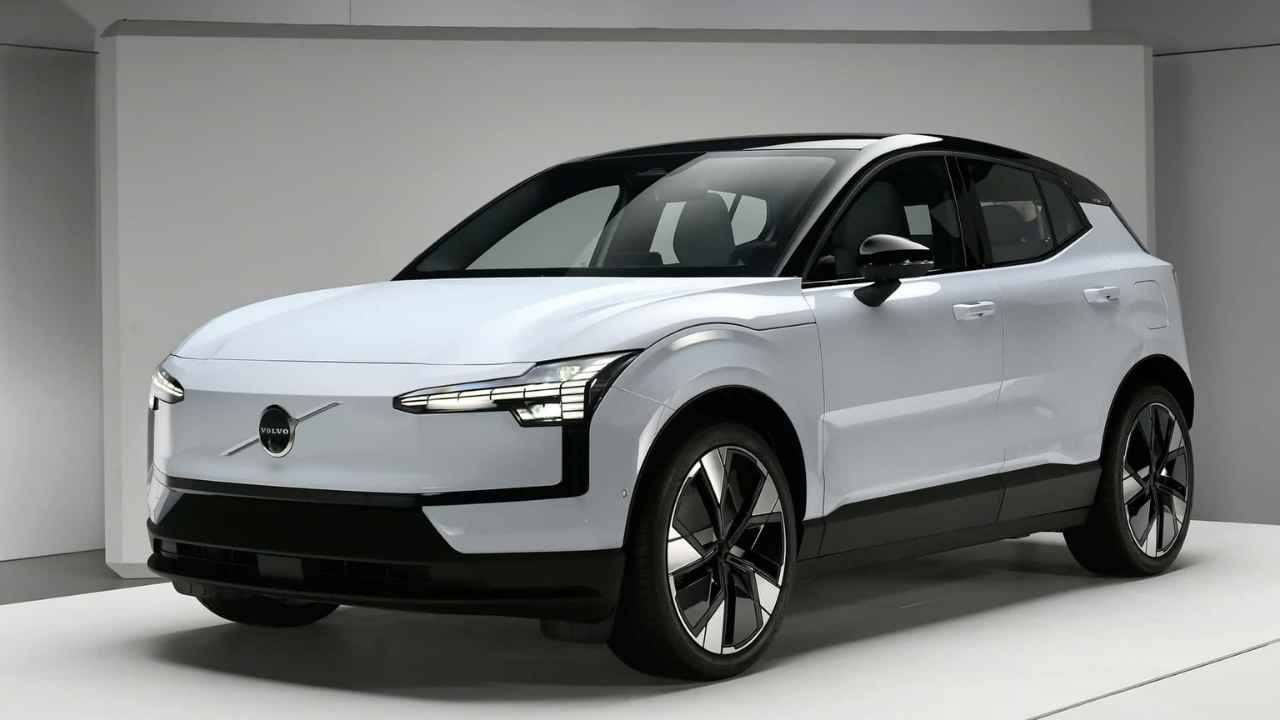
Volvo EX30: Electric vehicles (EVs) are causing a significant upheaval in the Indian auto industry. More consumers are choosing electric vehicles as a result of government regulations, increased environmental consciousness, and growing fuel prices. Affordable models like the Mahindra XUV400, MG Comet EV, and Tata Nexon EV dominated the Indian EV market until recently. However, there hasn’t been much research done on the luxury EV SUV market.
Volvo, a company well-known throughout the world for its safety and Scandinavian design, is now getting ready to make a big move with the Volvo EX30, its smallest and least expensive electric SUV. The EX30 is scheduled to make its debut in India in late 2025, following a successful global debut in 2023. This will be a significant step for the company’s EV strategy in India.
The EX30 is not just another SUV; it is made to provide sustainability, luxury, and small-footprint functionality at a cost that is reasonably affordable. The EX30, which is positioned beneath the Volvo XC40 Recharge, may draw in young professionals, urban families, and environmentally conscious consumers seeking a high-end EV without going overboard.
Volvo EX30: An International Success Prior to India
It’s important to note how well the EX30 has been received worldwide before getting into the specifics of India. Initially introduced in Europe, the United States, and a few Asian markets, the small SUV swiftly rose to the top of Volvo’s EV sales charts. Customers praised its combination of Volvo’s renowned safety, long range, stylish design, and reasonable price (by luxury standards).
Given that the EV market in India is about to blow up, its worldwide success suggests that the country may also embrace it enthusiastically. The Volvo EX30 has the advantage of being more cost-conscious than other luxury EVs like the Mercedes EQB or BMW iX1, which makes it a viable choice for a wider range of Indian luxury buyers.
Design and Construction Quality: Small but High-End
The Scandinavian minimalism that has made Volvo a household name is reflected in the design of the EX30. Despite its small size, it manages to look bold and high-end. Its length of about 4.2 meters makes it slightly larger than many Indian compact SUVs, including the Hyundai Creta, but shorter than the XC40 Recharge. Because of this, it is ideal for congested Indian cities where agility is crucial.
The exterior features clean aerodynamic lines, a closed-off EV grille, and Volvo’s iconic Thor’s Hammer LED headlights. The sleek, upward-extending vertical LED taillamps on the back give it a futuristic appearance. The SUV conveys luxury and functionality with its muscular road presence, despite its small size.
Volvo maintains an eco-friendly yet luxurious interior. Recycled plastics, fabrics made from flax, and metals that are sourced ethically are among the sustainable materials used in the construction of the cabin. A 12.3-inch central infotainment touchscreen running Google’s Android Automotive OS dominates the straightforward dashboard design. In contrast to the gloomy, combative interiors of German competitors, the soft-touch materials and pastel colours create a serene atmosphere.
Battery, Range, and Charging Options
One of the strongest selling points of the Volvo EX30 is its impressive battery and range options. Globally, Volvo offers multiple variants:
- Single Motor Standard Range (51 kWh battery) – Around 344 km WLTP range.
- Single Motor Extended Range (69 kWh battery) – Around 480–500 km WLTP range.
- Dual Motor Performance (69 kWh battery, AWD) – Range around 460 km WLTP but with sportier performance.
For India, the Extended Range variant is expected to be the focus since long driving range is a top priority for Indian buyers.
It is also user-friendly due to the charging options. The EX30 can be charged from 10% to 80% in just 25 minutes using DC fast charging (using a 175kW charger). It takes about eight hours to fully charge on a standard AC home charger (7.4kW), making it appropriate for overnight charging.
The EX30’s practicality for both city commutes and intercity travel stems from its balance of range and convenience, which is crucial in India, where charging infrastructure is expanding but still sparse.
Driving Dynamics and Performance
The EX30 was designed by Volvo to be both enjoyable to drive and useful.
- With rear-wheel drive, the Single Motor version produces about 272 horsepower and can go from 0 to 100 km/h in 5.7 seconds.
- The Dual Motor Performance version is the fastest-accelerating Volvo ever produced, with an incredible 428 horsepower and all-wheel drive that reduces the sprint time to just 3.6 seconds.
Volvo may give the rear-wheel-drive Extended Range model priority for Indian conditions because it strikes a balance between affordability, efficiency, and performance. But if the Dual Motor version comes out, fans will adore it.
The suspension of the EX30 has been adjusted to maintain stability on highways and offer comfort on city streets. It promises to be a pleasure to drive in city traffic and to handle lengthy trips with ease because of its small size and powerful torque delivery.
Infotainment, Technology, and Interior
Volvo’s tech-first approach is being carried over into the EX30. The 12.3-inch vertical touchscreen, which runs Google Android Automotive and has Google Assistant, Maps, and the Play Store built right in, is the standout feature. Although wireless Apple CarPlay is also included, this removes the need for external smartphone mirroring.
Convenience is increased by wireless charging, numerous USB-C ports, and a digital instrument cluster, while immersive audio quality is guaranteed by a high-end Harman Kardon sound system (available in higher trim levels).
Despite its small size, Volvo has made the cabin layout as efficient as possible. While it’s a little tight for three adults, the rear legroom is adequate for two. For small families, the boot’s 318 litres of storage can be expanded to 622 litres when the seats are folded.
With four interior “themes” that creatively employ recycled materials, Volvo has also placed a strong emphasis on sustainable design. Customers who care about the environment and want luxury without compromising it will find this appealing.
Safety Features: The Main Advantage of Volvo
Volvo remains at the forefront of safety. It is anticipated that the EX30 will come to India equipped with a comprehensive set of safety features, such as:
- ADAS (Advanced Driver Assistance Systems) that include blind-spot detection, adaptive cruise control, and lane-keep assistance.
- Collision Mitigation Support to identify vehicles, cyclists, and pedestrians.
- Pilot Assist is a semi-autonomous highway driving aid.
- Automated parking in confined spaces is possible with Park Pilot Assist.
- ISOFIX child seat mounts, a 360-degree camera, and airbags.
These features will be very appealing to buyers who value their own and their families’ safety, especially considering India’s inconsistent road conditions.
Variants and Indian Expected Prices
The Volvo EX30 has a very aggressive price tag worldwide, with prices starting at about €36,000 (₹32 lakh) in Europe. Following import taxes and localization considerations, the anticipated price range for India is between ₹40 lakh and ₹50 lakh (ex-showroom).
- Base Model (Single Motor): approximately 40 lakhs
- The Extended Range Variant costs about 45 lakh rupees.
- If released, the Dual Motor AWD Variant will cost about ₹50 lakh.
With this price, the EX30 would be more reasonably priced to enter the luxury EV market than competitors like the Mercedes EQB (~₹75 lakh) and BMW iX1 (~₹66 lakh).
Competitor Comparison in India
The Volvo EX30 will face stiff competition from multiple EVs in India:
- BMW iX1 – Premium German luxury EV SUV but significantly more expensive.
- Mercedes EQB – 7-seater EV SUV with higher pricing.
- Kia EV6 – Stylish, performance-oriented EV but costs above ₹60 lakh.
- BYD Atto 3 – Mid-size Chinese EV with strong value but lacks brand trust compared to Volvo.
- MG ZS EV – More affordable but positioned in a lower segment.
Here, Volvo EX30 strikes a balance between luxury, affordability, and brand trust, which could give it a strong edge.Volvo EVs’ future in India
The EX30 is only the first step. Volvo has already stated that it intends to switch to electric vehicles worldwide by 2030. The EX30 may become the luxury EV market’s volume driver in India following the XC40 and C40 recharges. If successful, it could open the door for Volvo to introduce larger SUVs like the EX90 and other EV models to India.