

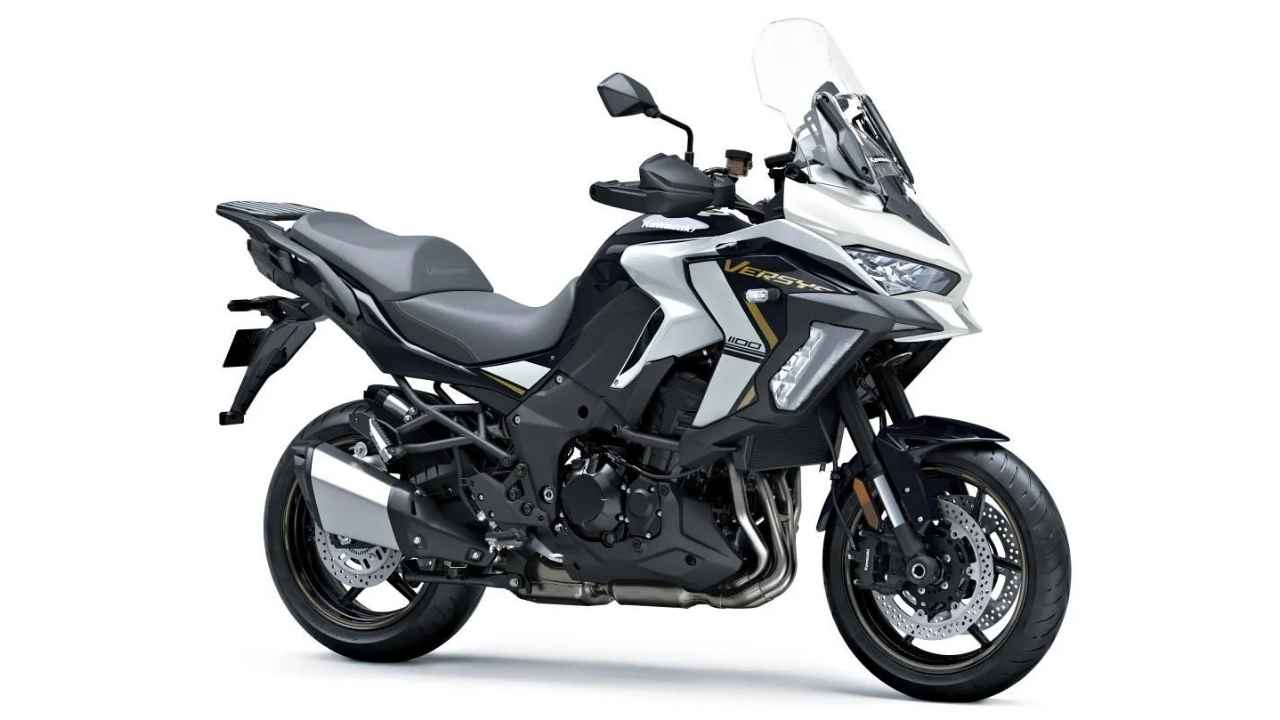
Kawasaki Versys 1100: The Kawasaki Versys series is one of the few motorcycle models that can do all three: be sporty, be comfortable for touring, and be ready for anything. Kawasaki has improved its top-of-the-line big-bike tourer, the Versys 1100, for 2025. This is a small but important change from the popular Versys 1000. The Japanese company has added more power and torque to an already capable platform by increasing the displacement to 1,099cc. This ensures that it meets stricter emissions standards while also making it easier to use. The Versys 1100 is a do-it-all bike that puts comfort first without sacrificing fun. Whether you’re carving canyon roads, going on cross-country trips, or just commuting through urban sprawl, the Versys 1100 is the bike for you.
The 2025 Versys 1100 looks a lot like the 2020 Versys 1100 at first glance. Kawasaki’s design philosophy is still based on functional aesthetics, with sharp, flowing lines that are inspired by the Ninja H2. The two LED headlights cut through the night with precision, and the small turn signals on the sides add to the effect. The sculpted bodywork makes the car more comfortable to drive. The colors work together perfectly from front to back, giving the impression of movement even when the car is parked. The bike comes in different models, such as the base Versys 1100, the tech-laden S, and the top-of-the-line SE LT. Its aggressive yet inviting design, with its tall, upright stance, draws riders in. The adjustable windscreen and optional tall flyscreen do a great job of keeping the wind out, which makes long rides less tiring. The SE LT model weighs about 545 pounds (wet), so it’s not light, but its balanced chassis makes it feel quick and stable.
The star of the show is a liquid-cooled, DOHC inline-four engine that has been improved to appeal to a wider audience. It’s under the hood, or rather, the trellis frame. The 2025 model has a bigger engine than the 2020 model, going from 1,043cc to 1,099cc. This increases the power output to 133 horsepower at the crank and 82.5 lb-ft of torque. Kawasaki didn’t just look at the numbers; they also focused on how well the bike responded in the middle and low ends. Updates include longer airbox intake funnels, narrower intake ports, revised cam profiles, lighter Keihin throttle bodies, and a heavier flywheel for smoother delivery. Electronic throttle valves make sure that power is applied smoothly, and tweaked gear ratios help with faster acceleration and lower cruising RPMs on highways. This is perfect for keeping the engine from straining while going 70–80 mph.
The end result is a smoothness that is typical of Kawasaki. Reviewers love how well it controls vibrations, which makes it great for touring all day. The Versys 1100 goes forward with the same excitement as a superbike in Sport mode, reaching 60 mph in less than 3.5 seconds. The bike turns into a mile-munching cruiser when you switch to Road or Rain modes, which make the power mapping more flexible. The 5.5-gallon tank gives you a real-world range of more than 250 miles, and the car gets about 45–50 mpg. With a slipper/assist clutch and a standard up/down quickshifter, shifting is easy, so riders can focus on the ride.
The Versys 1100 is great at handling because it has adventure-touring DNA. The suspension setup is different for each trim. The base model has manual adjustments and 5.9 inches of travel in the front and back. The SE model adds Kawasaki Electronic Control Suspension (KECS) with Showa Skyhook technology. This semi-active system changes the damping automatically based on the road conditions, giving you a smooth ride over potholes and a firm grip in corners. The bike’s 43mm inverted forks and horizontal back-link shock absorb bumps easily, and the 33.5-inch seat height is good for taller riders while still being easy to get on and off. The 17-inch wheels with Dunlop Trailsmart tires give you a strong grip on pavement and are flexible enough to handle light gravel detours.
The brakes are just as good, with four-piston calipers squeezing two 310mm front discs and a bigger 260mm rear disc (up 10mm from 2024) for better stopping power. All models come with ABS, and the S and SE models have cornering management through a Bosch IMU. This inertial measurement unit also lets you use advanced rider aids like four power modes (Sport, Road, Rain, and Rider), traction control, engine braking control, and cruise control. The SE LT comes with heated grips, a USB-C port, and 28-liter color-matched panniers, making it ready for touring. The Rideology app now lets you use voice commands to navigate and make calls on your smartphone, which is great for riders who wear gloves. The higher trims have a TFT display that is clear and can be changed to fit your needs. It combines digital readouts with an analog tachometer to give you that classic feel.
The Versys 1100 does a great job of what it’s meant to do on the road. Journalists who recently test drove it in Baja California said it handled well on winding coastal highways. The new engine’s torque made it easy to pass without having to downshift. The upright design puts less stress on the wrists and back, and the passenger space is large, with a roomy back seat and an optional backrest. It’s not a true ADV bike that can go off-road, but its 7.1-inch ground clearance makes it great for city curbs and the occasional dirt path. The low-end grunt makes it easy to move around in city traffic, even though it’s big.
The base Versys 1100 costs about $14,999, the S costs $16,749, and the SE LT ABS costs $19,499 in the U.S. This puts it in a good place against competitors like the Yamaha Tracer 9 GT ($15,999), which has a triple-cylinder smoothness but less power, and the Suzuki GSX-S1000GT ($13,999), which is praised for being cheap but criticized for having harsher brakes and engine refinement. The Versys has better technology and a four-cylinder engine, but some people say that the Honda NT1100 is better at the same level of refinement. For budget-conscious buyers, the 2025’s upgrades may not be worth the extra money compared to older Versys models. However, for new owners, the extra torque and electronics make the deal.
The Kawasaki Versys 1100 is a great choice for Japanese reliability at a much lower price than German heavyweights like BMW’s R 1300 GS. It’s not a game-changer, but the changes it has made over time have made it more useful than ever. The Versys 1100 is a great choice for riders who want a comfortable, capable tourer that can also handle spirited rides. One reviewer said it’s “touring perfection” for people who like things to be balanced instead of extreme. This bike is built to last, with Kawasaki’s famous durability and a four-year warranty (plus two more years in 2025). It’s ready to go the distance and make memories.